coreQ AI Unveils Data Infrastructure Roadmap for the Next Generation of Physical AI
Newsfile
October 04, 2026 2:40AM GMT
Silicon Valley-based coreQ AI combines causal AI with scalable real-world robotics data production to address a growing bottleneck in high-value training data.
Silicon Valley, California--(Newsfile Corp. - October 3, 2026) - coreQ AI today unveiled its roadmap for Physical AI data infrastructure, outlining a system that connects real-world robotics data production with model training, evaluation, and reusable robot capabilities. The roadmap focuses on four areas: working backward from model requirements to define data needs, using causal AI to assess data value, standardizing production for scale, and building a global production network to improve cost efficiency over time.

To view an enhanced version of this graphic, please visit:
https://images.newsfilecorp.com/files/9113/316963_fdb026c5f43d8bc0_001full.jpg
The company said its data production and delivery capabilities have been validated in real-world testing with a leading global technology company. Building on those results, coreQ AI is scaling its production capacity and global delivery network. The company also plans to deepen its engagement with the Silicon Valley AI and robotics ecosystem while expanding real-world data collection and production capacity across Asia.
Key Technical Validation Results
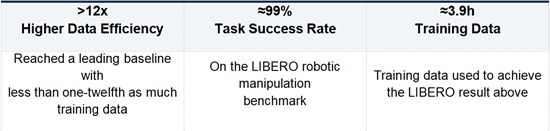
To view an enhanced version of this graphic, please visit:
https://images.newsfilecorp.com/files/9113/316963_fdb026c5f43d8bc0_002full.jpg
Note: The results above come from robotic manipulation experiments using causal-learning technologies related to coreQ AI. They support the company's technical thesis that competition in Physical AI data will depend not only on data volume, but also on the ability to identify data with greater training value.
Work Backward From Model Requirements
As Physical AI moves toward larger-scale training and deployment, the central data question is shifting from how much data can be collected to what data models actually need. Members of coreQ AI's core technical team have experience working at industrial frontier labs and world-class AI companies in Silicon Valley. That experience informs the company's approach to defining data tasks, structures, labeling systems, collection protocols, and quality standards for model training, post-training, and evaluation.
Under this framework, data production starts not with what is easiest to collect, but with the real-world experience a robot needs to acquire its next capability. coreQ AI plans to connect model performance, task outcomes, and data production so that each collection effort is tied to a specific capability objective.
Use Causal AI to Identify High-Value Data
Assessing data value is the second core element of the roadmap. coreQ AI is applying causal AI to Physical AI data production and evaluation. Its causal AI scientists are developing methods to analyze data value and identify the factors that materially affect model performance across successful and failed robot tasks and changing environmental conditions.
For robot tasks that fail repeatedly, the approach can analyze relationships among object position, contact conditions, material changes, environmental variables, and task outcomes, then use those findings to guide the next round of targeted data collection. The goal is to move beyond data volume alone and generate real-world experience that addresses specific model capability gaps.
"The key to Physical AI data infrastructure is not simply producing more data," said ZC.Yao, Chairman of coreQ AI. "The challenge is to answer three more specific questions: What data does the model need next? How can that data be produced reliably at scale? And how can unit production costs be reduced over time? Our goal is to connect model requirements, data-value assessment, scaled production, and evaluation so that each production cycle contributes more directly to improving robot capabilities."
Scale Robotics Data Production Beyond One-Off Projects
Physical AI data production spans operators, robot embodiments, sensors, facilities, task design, quality control, and data processing. coreQ AI is developing standardized task design, collection workflows, quality-control processes, and delivery systems to move robotics data production beyond one-off projects and toward a scalable network spanning locations, tasks, and robot embodiments.
Under the roadmap, common task specifications, data standards, and quality systems are designed to be replicated across production nodes, with capacity expanding as customer models iterate and training needs grow. By standardizing workflows that can be replicated across sites and scaled over time, coreQ AI aims to turn real-world robotics data from a one-time delivery capability into continuously scalable infrastructure.
Build a Production Network Across Asia to Achieve Economies of Scale
Following initial validation of its technology and delivery capabilities, coreQ AI is expanding real-world data collection and production across Asia. The company plans to leverage the region's engineering talent, robotics supply chain, facility availability, and operating capacity to increase production while maintaining the data and quality standards required by large technology companies and reducing the unit cost of effective training data over time.
coreQ AI plans to build a global data production system that combines close proximity to Silicon Valley AI and robotics development with scalable production capacity in Asia. Technical teams close to Silicon Valley's AI and robotics ecosystem will interpret model requirements and define data and quality standards, while a global production network, particularly in Asia, will support scalable production of high-quality Physical AI data.
From Data Infrastructure to Capability Infrastructure
Under the roadmap, coreQ AI will use real-world robotics data as its initial commercial entry point, then expand into training, post-training, evaluation, and reusable robot capabilities. The company describes this as a long-term progression from data infrastructure to training infrastructure to capability infrastructure.
The resulting iteration loop connects real-world data production, model training, capability evaluation, gap identification, and targeted data collection. As robot embodiments, tasks, and operating environments evolve, the system is designed to generate new data requirements and convert real-world experience into robot capabilities that can be evaluated and iterated.
coreQ AI's long-term goal is to become a Physical AI data infrastructure company that understands what data AI models need and can continuously produce that data at global scale.
About coreQ AI
coreQ AI is a Silicon Valley-based Physical AI company developing data infrastructure for robotics. Its approach combines model-driven data definition, causal AI, scalable real-world data production, training, and evaluation, with the long-term goal of turning real-world experience into reusable robot capabilities.
Media Contact
Jessica Wong
Email: [email protected]
Website: https://coreqai.ai/
To view the source version of this press release, please visit https://www.newsfilecorp.com/release/316963
