Frost & Sullivan Releases the Global Brain-Computer Interface Industry Development White Paper
Newsfile
October 24, 2026 3:56PM GMT
Shanghai, China--(Newsfile Corp. - October 24, 2026) - On October, 2026, Frost & Sullivan has conducted comprehensive research on the global brain-computer interface industry and published the Global Brain-Computer Interface Industry Development White Paper. (To read the report, please visit: https://go.frost.com/tgp/hls/bcicommercialization)
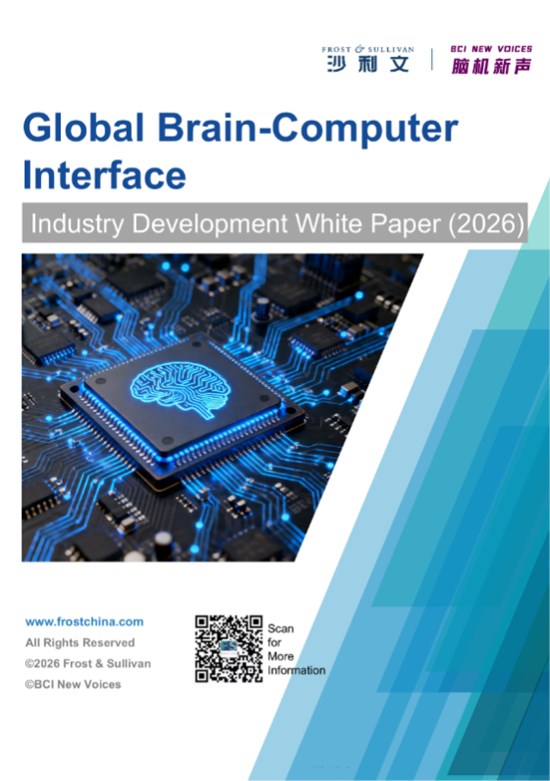
To view an enhanced version of this graphic, please visit:
https://images.newsfilecorp.com/files/7987/320348_c87d11a5c41f5aa4_001full.jpg
As a disruptive frontier technology bridging carbon-based biological intelligence and silicon-based artificial intelligence, Brain-Computer Interface (BCI) is widely recognized as a revolutionary track reshaping the underlying paradigm of human-computer interaction. Integrating neuroscience, information science, materials engineering, clinical medicine and artificial intelligence, BCI carries humanity's long-term vision of unraveling brain mysteries, repairing neural functions and expanding cognitive boundaries. Breakthroughs in BCI technology not only revolutionize the research paradigm of brain science, but also act as a core engine to incubate next-gen intelligent industries, develop new productivity and seize commanding heights in global future technology competition.
Currently, the global BCI industry is at a critical window of transition from fundamental research to clinical translation and validation. Countries worldwide are intensifying efforts in frontier innovation, establishing comprehensive layouts across core devices, decoding algorithms, clinical applications, and ethical standards. As an authoritative global growth consulting firm in frontier technology and industrial development, Frost & Sullivan—leveraging its continuous insights into the BCI sector, 65 years of deep research expertise across global markets, and extensive global industry data and case studies—has partnered with BCI NEW VOICES to officially release the Global Brain-Computer Interface Industry Development White Paper (2026).
Built upon close collaboration among government, industry, academia, research, finance, end-users, and services, the White Paper presents a systematic and in-depth global study. It comprehensively maps out technical pathways, industrial policies, innovation resources, and commercial practices across different countries and regions. By benchmarking leading global innovation teams, industry leaders, specialized industrial parks, and innovation platforms, the report objectively analyzes the global competitive landscape, highlighting key strengths, bottlenecks, and development gaps.
Taking a global perspective, the report evaluates technical shifts, business model evolutions, industry standards, and ethical governance frameworks to chart a sustainable path that balances innovation with risk management, fostering both global collaboration and localized breakthroughs. The White Paper aims to drive the integration of innovation elements across the supply chain, facilitate cross-regional resource synergies, and promote healthy, balanced industrial growth. Ultimately, it provides actionable, systematic global strategies and recommendations, offering forward-looking, structured insights for government bodies, investors, industry leaders, and the broader community.
Key Takeaways
- Medical BCIs need to prove better patient outcomes: Adoption will rely on evidence that these systems safely improve movement, communication, rehabilitation, or symptom control compared with existing treatments.
- Consumer BCIs need to prove their everyday value: Non-invasive devices are easier to launch, but inconsistent signal quality and limited essential demand could reduce willingness to pay and continued use.
- Real-world integration will shape scale: Providers need to plan for system integration, user training, neural data protection, software updates, maintenance, and long-term support-not just device development.
- Commercialization requires more than technical performance: Clinical evidence, regulatory pathways, user experience, affordability, and sustainable business models will increasingly determine which BCI applications progress beyond trials.
- Brain-computer interfaces allow the human brain to communicate directly with external systems, creating new ways to study neural activity and restore neurological functions. This potential has encouraged research across neuroscience, artificial intelligence (AI), materials engineering, information science, and clinical medicine. These multidisciplinary efforts are bringing BCIs closer to clinical translation and validation.
- As BCIs move toward practical use, technical improvements in devices and decoding methods will not be enough. Developers must also demonstrate that these systems are safe, reliable, and effective outside controlled research settings. Alongside growing investment, this need for real-world validation is bringing greater attention to the standards and governance frameworks required to guide BCI development.
The chapters of the Global Brain-Computer Interface Industry Development White Paper are as follows:
| |
| |
| |
| |
| |
| |
| |
| |
| |
2.1 Core Technology Framework | |
2.2 Neural Signal Acquisition Technologies | |
2.3 Signal Processing and Decoding Algorithms | |
2.4 Encoding and Neural Stimulation Feedback Technologies | |
2.5 Key Hardware and Engineering Implementation | |
2.6 Key Hardware — Chips | |
| |
3.1 Parkinson's Disease | |
3.2 Epilepsy | |
3.3 Pain Management | |
3.4 Spinal Cord Injury | |
3.5 Stroke | |
3.6 Blindness | |
3.7 Language/Speech Disorders | |
3.8 Depression | |
3.9 Attention Deficit Hyperactivity Disorder (ADHD) | |
3.10 Hearing Loss | |
| |
| |
|
|
| |
| |
| |
5.1.1 U.S. BCI Regulatory Pathway 5.1.2 Analysis of U.S. BCI Industry Policies | |
| |
5.2.1 U.S. BCI Regulatory Pathway 5.2.2 Analysis of U.S. BCI Industry Policies | |
| |
| |
| |
6.2.1 University Research Strength Driving Technological Innovation 6.2.2 Capital Racing In, with Leading Players Dominating | |
| |
6.3.1 Multi-Front Breakthroughs in Frontier Research Advancing Innovation 6.3.2 Building Industrial-Grade Infrastructure to Solve Translation Bottlenecks 6.3.3 BCI Wards Accelerating the "Last Mile" of Clinical Translation 6.3.4 A Financing Landscape of Frequent Deals, Diverse Pathways and an Expanding Ecosystem 6.3.5 Growing Regional Clustering, Forming a New "Multi-Tier, Complementary" Landscape | |
| |
| |
|
About Frost & Sullivan
Frost & Sullivan is a growth consulting firm dedicated to partnering with clients to leverage visionary innovation that addresses global challenges and capitalizes on related growth opportunities to drive the success of today's market participants. For over 60 years, Frost & Sullivan has been providing growth strategy support to the Global 1000, emerging businesses, the public sector, and investment institutions.
Media Contact
Contact Person: Jacky Yang
Company: Frost & Sullivan
Website: http://www.frostchina.com
Email: [email protected]
To view the source version of this press release, please visit https://www.newsfilecorp.com/release/320348
