LCIF Approves US$1.6 Million Grant to Expand Youth Prevention Programs Across Southeast Europe
Newsfile
June 18, 2026 6:02PM GMT
Oak Brook, Illinois--(Newsfile Corp. - June 18, 2026) - The Lions Clubs International Foundation (LCIF) Board of Trustees has approved US$1.6 million in grant funds to support the continued expansion of Lions Quest, LCIF's premier education and youth development program, across Southeast Europe. The initiative will be facilitated in partnership with the United Nations Office on Drugs and Crime (UNODC) and aims to deliver proven life skills education that strengthens young people, schools, families and communities throughout the region.
The four-year initiative will support teacher training, curriculum expansion, regional collaboration, program evaluation and public awareness efforts through 2029 in Bosnia and Herzegovina, Montenegro, North Macedonia, Serbia and Slovenia.
The grant funds will introduce Lions Quest Skills for Growing in Bosnia and Herzegovina for the first time, expand Skills for Adolescence into additional schools in Slovenia, Montenegro and North Macedonia and launch or expand Skills for Action and service-learning programs in Bosnia and Herzegovina, Montenegro and Serbia.
Since 2014, more than 56,000 students across the region have participated in Lions Quest programs, with significant growth occurring over the last three years.
One of those students was Stefan Popovic of Montenegro, who participated in Lions Quest Skills for Adolescence while in school. In 2019, he spoke at the United Nations about his experience with the program. Five years later, he returned to share how Lions Quest continued to shape his life and decision-making.
"Our life, and especially our adolescence, depends on the decisions we make. [Lions Quest] Skills for Adolescence improved our way of making decisions. It taught us to think well before making a decision, and to think about its consequences and its benefits and drawbacks," he said.
"Seeing the positive impact the program made on my generation, I'm certain that it will continue to guide and to inspire many more young people in the years to come," he added.
The initiative is being implemented in close collaboration with Ministries of Education, local educators and Lions volunteers throughout the region. In several participating countries, Ministries of Education have reviewed, certified or accredited Lions Quest materials for classroom use.
Local Lions play a critical role in the program's expansion by helping coordinate teacher training workshops, identifying schools for participation and strengthening collaboration with national education leaders.
As part of the initiative, Lions Quest materials have been translated and culturally adapted into six regional languages. The partnership also includes ongoing monitoring and evaluation efforts, with findings published in peer-reviewed journals and additional studies currently underway.
The new funding builds on a long-standing partnership between LCIF and UNODC, reaffirmed earlier this year through a renewed Memorandum of Understanding signed during Lions Day with the United Nations in Vienna.
"Our partnership with LCIF demonstrates that prevention works best when it is evidence based, sustained and rooted in communities. Together, we are equipping young people with the skills and resilience they need to build safer and healthier futures," said Dr. Justice Tettey, UNODC Chief of the Drugs, Laboratory and Scientific Services Branch.
For more than a decade, LCIF and UNODC have collaborated to promote research, best practices and prevention systems that support the mental and physical well-being of children and young adults, in alignment with UNODC and World Health Organization international standards on drug use prevention and the Sustainable Development Goals.
"Through Lions Quest, students are gaining critical life skills that help them make healthy decisions, build resilience, and contribute positively to their communities," said LCIF Chairperson Fabrício Oliveira. "This investment reflects our commitment to empowering young people and supporting schools and communities worldwide with proven, evidence-based resources."
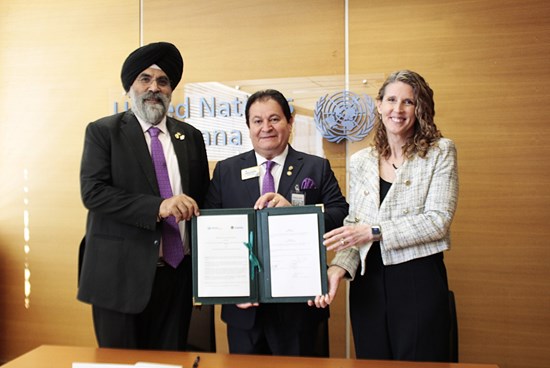
Lions Clubs International President A.P. Singh, LCIF Chairperson Fabrício Oliveira and Candice Welsch, Director of the Division for Policy Analysis and Public Affairs at the United Nations Office on Drugs and Crime (UNODC), renew their partnership agreement during Lions Day at the United Nations in Vienna, Austria.
To view an enhanced version of this graphic, please visit:
https://images.newsfilecorp.com/files/9322/302088_c7b0c17f64c87b0b_001full.jpg
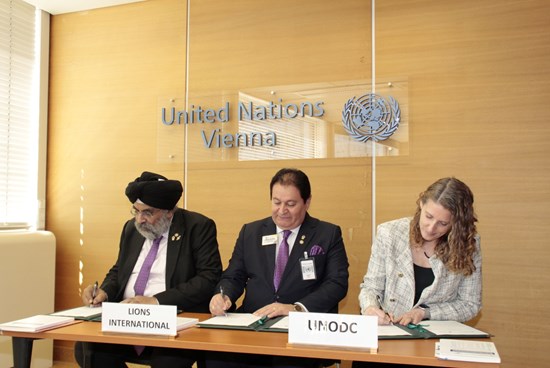
Lions Clubs International President A.P. Singh, LCIF Chairperson Fabrício Oliveira and Candice Welsch, Director of the Division for Policy Analysis and Public Affairs at the United Nations Office on Drugs and Crime (UNODC), renew their partnership agreement during Lions Day at the United Nations in Vienna, Austria.
To view an enhanced version of this graphic, please visit:
https://images.newsfilecorp.com/files/9322/302088_c7b0c17f64c87b0b_002full.jpg
About Lions Clubs International Foundation
Lions Clubs International Foundation (LCIF) is the global foundation supporting the 1.4 million members of Lions Clubs International through grant funds that expand their compassionate works and empower their service at home and around the world. Since its founding in 1968, LCIF has awarded more than 25,000 grants totaling more than US$1.3 billion. We improve health and well-being, strengthen communities and support those in need, locally and globally. Learn more about who we are and what we do at lionsclubs.org/lcif or donate to LCIF at lionsclubs.org/donate. Follow LCIF on Facebook at @LCIFLions.
About UNODC
The United Nations Office on Drugs and Crime (UNODC) supports Member States in preventing drug use and crime, strengthening justice systems, and promoting the rule of law. Through partnerships with governments, civil society and the private sector, UNODC delivers evidence-based prevention and capacity-building programmes that help protect vulnerable populations and build safer communities worldwide.
Learn more about UNODC's work to prevent drug use and strengthening health and development systems worldwide at unodc.org. Follow UNODC for updates on evidence-based prevention and global partnerships on X at @UNODC_PTRS and on LinkedIn.
Contact information:
Hannah Krzeminski
[email protected]
To view the source version of this press release, please visit https://www.newsfilecorp.com/release/302088
