Spartan Metals Geophysical Surveys Indicate Potential Tungsten-Silver Veins Extension at Its Tungstonia Claims, Nevada
Newsfile
September 18, 2026 9:00AM GMT
- Indicates Approximately 700 Meters of depth potential to veins
- Surveys also identify a related 3.7 km² potential porphyry target
- Tungstonia appears to host a dynamic mineralizing system with potential for multiple styles of mineral deposits
Vancouver, British Columbia--(Newsfile Corp. - September 18, 2026) - Spartan Metals Corp. (TSXV: W) (OTCQB: SPRMF) (FSE: J03) ("Spartan" or the "Company"), an exploration and development company focused on tungsten and critical minerals in the western United States, announces the results of the magnetotelluric ("MT") and direct-current induced polarization ("DCIP") geophysical surveys completed at the Tungstonia Claims on its 100% owned Eagle Tungsten-Silver-Rubidium Project ("Eagle" or the "Project") in White Pine County, Nevada.
The surveys deliver Spartan's first three-dimensional dataset beneath its Tungstonia Claims. The data set agrees well with mapped structures, geology, surface geochemistry and with the projected geological model at depth providing a coherent picture which has produced new and exiting targets for the Eagle Project. Based on our interpretation of the geophysical anomalies, the veins worked almost a century ago are projected to continue to depths of up to approximately 700 meters (m) that could potentially be connected to a larger intrusion related target beneath. Together the two are interpreted as different parts of one larger mineralizing system, linked by the structures the veins occupy.
"These surveys have given us our first look beneath the legacy workings at Tungstonia and across the Tungstonia Claims. We are very pleased at how well the results line up with the geological model our team built from surficial data," said Rebecca Ball, Spartan's Vice President of Exploration. "We are excited that we can see anomalies that coincide with our surface veins apparently continuing to depth and that we have also identified an intrusive target that may be the source of the fluids that formed them. We believe we have a coherent picture of one potentially large mineralizing system with several strong targets across the Eagle Project that we can drill with clear rationale behind each one."
Highlights
- Tungsten-silver veins imaged to depths of up to approximately 700 meters. DC resistivity resolves Veins 1 through 5 and their greisen alteration envelopes below surface, carrying the same strike and dip at depth that Spartan has mapped at surface (Figures 1 and 2).
- A 3.7 km² porphyry target defined between approximately 400 m and 1,800 m depth. Identified by MT along the 0500N line within carbonate-dominated sedimentary units adjacent to the interpreted NNE Sims Canyon Fault (Figure 3) – a target style not previously identified at Tungstonia.
- The veins and the porphyry target are interpreted as parts of one larger system. The veins occupy pre-existing structures that project downward toward the interpreted intrusive body, consistent with those structures having acted as feeders carrying tungsten-bearing fluids upward into the Tungstonia vein system.
- Distinct CRD potential where the same fluids meet limestone. A potential carbonate replacement ("CRD") style target on the western side of DCIP Line 1570N sits where interpreted fluid pathways contact the prospective Guilmette Limestone which is a different another style of mineralization expected on the flanks of the same system (Figure 4). A potential tungsten skarn target was defined on the eastern side of DCIP Line 0500N (Figure 5). Soil and rock chip samples collected in the area support a CRD system developing on the flank of the intrusion.
- Five priority targets now ready to rank for drilling. The strongest DCIP anomalies overlap known tungsten mineralization, quartz-vein development and legacy workings – the geophysics is responding where Spartan's geologists expected it to.
What These Results Mean
- How the surveys work. Both surveys map electrical properties of rock without disturbing the ground. MT sees beyond 1,500 meters with less detail; DCIP gives sharper detail to roughly 750 meters. MT is the deep, wide view; DCIP is the close-up. These surveys identify conductive, chargeable anomalies that coincide with massive sulfides associated with mineralizing systems.
- Known veins interpreted to continue at depth. The past-producing Tungstonia mine worked these veins near surface. Anomalies coincide with these veing and appear to continue to approximate depths of 700 meters, significantly more depth to test than was ever mined.
- The pieces fit together. A buried intrusion is the classic source of the heat and metal that forms tungsten veins like we see at Tungstonia's. Spartan has now imaged a candidate for that source below the tungsten-silver veins via the faults and fractures the veins occupy coalescing toward the possible intrusive source - the plumbing that is hypothesized to have channeled the fluids up. The data suggest one system: a source, a set of pathways, and the deposits those pathways fed.
- A dynamic system with additional opportunity on the flanks. As can be expected in this geological environment where the fluids intersected limestone instead of being constrained a fracture, they can dissolve and replace the limestones to form carbonate replacement deposits that are often silver-rich with associated lead, zinc, and copper. Spartan has identified a target of that character where the interpreted pathways meet limestone. The CRD is distinct from the veins but generated by the same system.
- The necessary caution. Geophysical surveys measure the contrast in physical properties of the rock, rather than lithology or metal content. These anomalies are interpreted in conjunction with surficial mapping and other survey techniques and therefore are not direct evidence of mineralization. Only drilling can confirm what is present. They are tools that focus targeting in conjunction with mapped geology, structure, and surface geochemistry.
A Single System: Deep Source, Structural Feeders and Reactive Host Rocks
The MT resistivity model has identified a potential porphyry target along the 0500N MT Line extending from approximately 400 m to 1,800 m depth and covering an interpreted area of approximately 3.7 km², within carbonate-dominated sedimentary units along the interpreted NNE Sims Canyon Fault (Figure 3). The DCIP survey, which maps resistivity together with chargeability, appears to resolve the quartz-huebnerite Veins 1 through 5 and their greisen envelopes to depths of up to approximately 700 meters, following the same strike and dip mapped at surface (Figure 2). This is the first time the vein system has been imaged below the Tungstonia workings.
Spartan interprets all of these features to be related. Quartz-huebnerite veins with greisen envelopes are characteristically sourced from evolved granitic intrusions, and the structures hosting Veins 1-5 are pre-existing faults and fractures that project downward toward the interpreted porphyry body. Spartan interprets these structures to have acted as feeder conduits, channelling tungsten-bearing fluids upward from the intrusive source into the trap sites now expressed as the Tungstonia vein system. Supporting this, a moderately chargeable DCIP anomaly sits directly above the interpreted porphyry target, and a northeast-trending geometry is present in both the MT and DCIP data on the 0500N line – two independent methods, at different depths and scales, resolving the same structural corridor.
The interpreted CRD target represents a distinct but genetically related opportunity. Where fluids migrating along these structures encountered reactive carbonate units replacement of the limestone can occur, forming carbonate replacement mineralization that is commonly silver-rich. The potential CRD target on the western side of DCIP Line 1570N occurs where interpreted fluid pathways contact the prospective Guilmette Limestone (Figure 4), and the potential skarn target on the eastern side of DCIP Line 0500N occupies a comparable setting at an interpreted intrusive contact (Figure 5). Together the surveys support one system expressed three ways: a potential intrusive source at depth, structurally controlled veins above it, and replacement-style targets where those fluids met limestone. Geophysical anomalies are not direct evidence of mineralization and must be tested by drilling.
Next Steps
Spartan is integrating the MT and DCIP inversions with its geological database to complete an updated 3D model of the Tungstonia system, prioritising areas where known mineralization, legacy workings, quartz-vein and greisen development, interpreted intrusive contacts and geophysical anomalies coincide. Targets with several coincident characteristics will receive the highest priority for drill testing, and the Company intends to provide further information as the interpretation is finalized.
Qualified Person Statement
The technical information contained in this news release has been prepared under the supervision of, and approved by Brett R. Marsh, CPG. Mr. Marsh is President and CEO of Spartan Metals Corp. and a "qualified person" as defined under National Instrument 43-101 – Standards of Disclosure for Mineral Projects.
References
1 Nevada Bureau of Mines and Geology, 1988, Bulletin 105 p213-217
2 USGS https://pubs.usgs.gov/periodicals/mcs2026/mcs2026-tungsten.pdf
About The Eagle Tungsten-Silver-Rubidium Project
The Eagle Project is a district-scale exploration opportunity containing three past-producing tungsten mines (Tungstonia, Yellow Jacket and Rees/Antelope) with reported historic production grades of 0.6-3.51% WO31, and rubidium and silver mineralization identified in Spartan's 2025-2026 sampling. Operations at these mines were from 1915 to 1942 with intermittent small-scale production occurring until 1956. Tungsten production from these mines totaled 8,379 short ton units at grades between 0.6%-0.9% WO31
Eagle is ~36.5 km² in size and located approximately 120 kilometers northeast of the town of Ely, in the Kern Mountains of White Pine County, Nevada. The Project covers 9,033 acres consisting of 445 Bureau of Land Management (BLM) unpatented lode mining claims.
Three deposit types are present at Eagle; Porphyry, Skarn, and Carbonate Replacement (CRD) that contain significant or anomalous grades of Tungsten (W), Silver (Ag), and Rubidium (Rb) plus Cu-Sb±Au-Pb-Zn-Bi-As across three project focus areas that also includes the potential to recover W-Rb-Ag from the legacy Tungstonia Mill Tailings.
About Spartan Metals Corp.
Spartan Metals is focused on developing critical minerals projects in well-established and stable mining jurisdictions in the western United States, with an emphasis on building a portfolio of strategic defense minerals including tungsten, rubidium, antimony, bismuth and arsenic.
Spartan holds an option to earn 100% of the Victorio Tungsten-Molybdenum Project in New Mexico and owns 100% of the Eagle Tungsten-Silver-Rubidium Project in Nevada. Victorio is an advanced exploration project that hosts a 2012 historical mineral resource estimate of tungsten-molybdenum mineralization, with beryllium and fluorspar also present; an updated mineral resource estimate and preliminary economic assessment are in progress. Eagle is a district containing three past-producing high-grade tungsten mines (Tungstonia, Rees and Yellow Jacket) where Spartan's sampling has also identified silver, rubidium, antimony, bismuth and indium mineralization. No mineral resource has been estimated at Eagle.
A qualified person has not done sufficient work to classify the Victorio historical estimate as current mineral resources or mineral reserves, and Spartan is not treating the historical estimate as current mineral resources or mineral reserves. See the Company's news release of March 17, 2026 and www.spartanmetals.com for the source, date, parameters and reliability of the historical estimate.
On behalf of the Board of Spartan
"Brett Marsh"
President, CEO & Director
Further Information:
Brett Marsh, M.Sc., MBA, CPG | President, CEO & Director | 1-888-535-0325 | [email protected]
Jeff Walker | VP, The Howard Group | 403-221-0915 | [email protected]
Neither the TSX Venture Exchange nor its Regulation Service Provider (as that term is defined in the policies of the TSX Venture Exchange) accepts responsibility for the adequacy or accuracy of this press release
Forward-Looking Statements
This news release contains statements that constitute "forward-looking statements." Such forward-looking statements involve known and unknown risks, uncertainties and other factors that may cause the Company's actual results, performance or achievements, or developments in the industry to differ materially from the anticipated results, performance or achievements expressed or implied by such forward-looking statements. Forward-looking statements are statements that are not historical facts and are generally, but not always, identified by the words "expects," "plans," "anticipates," "believes," "intends," "estimates," "projects," "potential" and similar expressions, or that events or conditions "will," "would," "may," "could" or "should" occur. Forward-Looking Information in this news release, Spartan has applied several material assumptions, including, but not limited to, assumptions that: the current objectives concerning the Company's projects can be achieved and that its other corporate activities will proceed as expected; that general business and economic conditions will not change in a materially adverse manner; that Executive Order 14415 will be implemented substantially as described and will not be amended, rescinded, enjoined or superseded; that implementing regulations and policy guidance will be issued within the timeframes contemplated by the Order; and that all requisite information will be available in a timely manner.
Although the Company believes the forward-looking information contained in this news release is reasonable based on information available on the date hereof, by their nature forward-looking statements involve known and unknown risks, uncertainties and other factors which may cause our actual results, performance or achievements, or other future events, to be materially different from any future results, performance or achievements expressed or implied by such forward-looking statements. By their nature, these statements involve a variety of assumptions, known and unknown risks and uncertainties and other factors, which may cause actual results, levels of activity and achievements to differ materially from those expressed or implied by such statements.
Examples of such assumptions, risks and uncertainties include, without limitation, assumptions, risks and uncertainties associated with general economic conditions; adverse industry events; future legislative, regulatory, policy and executive action developments, including the implementation, amendment or rescission of Executive Order 14415 and any regulations promulgated thereunder; changes in government procurement policy or defense spending; the Company's ability to access sufficient capital from internal and external sources, and/or inability to access sufficient capital on favorable terms; the ability of the Company to implement its business strategies; competition; the ability of the Company to obtain and retain all applicable regulatory and other approvals and other assumptions, risks and uncertainties.
THE FORWARD-LOOKING INFORMATION CONTAINED IN THIS NEWS RELEASE REPRESENTS THE EXPECTATIONS OF THE COMPANY AS OF THE DATE OF THIS NEWS RELEASE AND, ACCORDINGLY, IS SUBJECT TO CHANGE AFTER SUCH DATE. READERS SHOULD NOT PLACE UNDUE IMPORTANCE ON FORWARD-LOOKING INFORMATION AND SHOULD NOT RELY UPON THIS INFORMATION AS OF ANY OTHER DATE. WHILE THE COMPANY MAY ELECT TO, IT DOES NOT UNDERTAKE TO UPDATE THIS INFORMATION AT ANY PARTICULAR TIME EXCEPT AS REQUIRED IN ACCORDANCE WITH APPLICABLE LAWS.
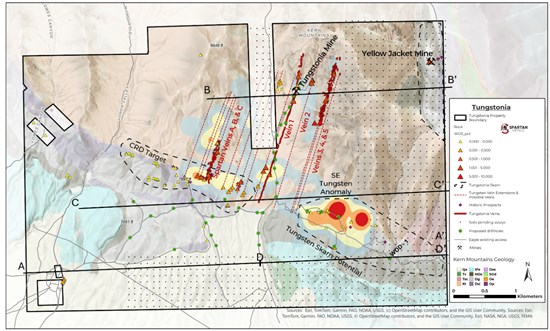
Figure 1 Drill sites (green) shown with 2024 and 2025 rock samples, 2025 tungsten soil results, interpreted geology, and 2026 soils pending assays. All Cross Section lines coincide with recent geophysics lines. 2026 drill priorities are to test the SE Tungsten Anomaly, depth extension of Vein 1 with potential to delineate additional interpreted veins to the west, the potential southward extension of the Spartan A, B, and C Vein complex and high-potential near-surface geophysical anomalies. Multiple holes may be drilled from a drill site.
To view an enhanced version of this graphic, please visit:
https://images.newsfilecorp.com/files/12484/314916_f495dda4d4b1c91d_001full.jpg
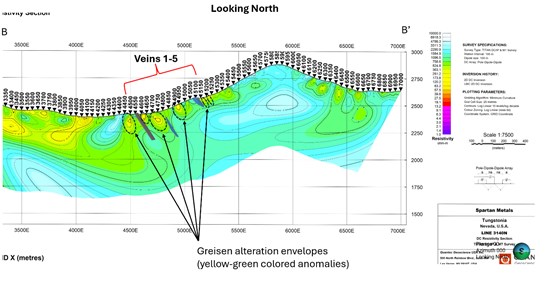
Figure 2 Cross Section B-B' showing DC Resistivity with greisen alteration around resistant quartz-huebnerite Veins 1-5. Veins 1-5 are interpreted from the DC resistivity data to extend to depths of up to approximately 700 m.
To view an enhanced version of this graphic, please visit:
https://images.newsfilecorp.com/files/12484/314916_f495dda4d4b1c91d_002full.jpg
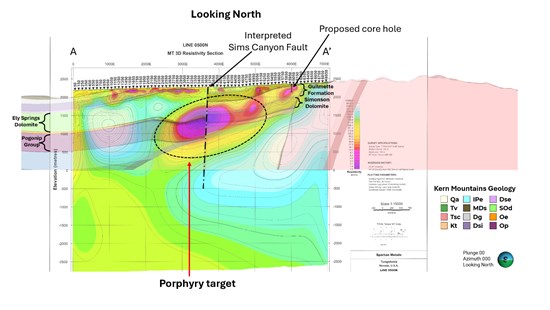
Figure 3 Cross Section A-A' showing 3D MT Resistivity. The interpreted Sims Canyon Fault, porphyry target, carbonate dominant sedimentary units, and a 2026 core hole shown to test high conductivity near surface targets (pink, red, orange, and yellow contours) within the prospective Guilmette Limestone.
To view an enhanced version of this graphic, please visit:
https://images.newsfilecorp.com/files/12484/314916_f495dda4d4b1c91d_003full.jpg
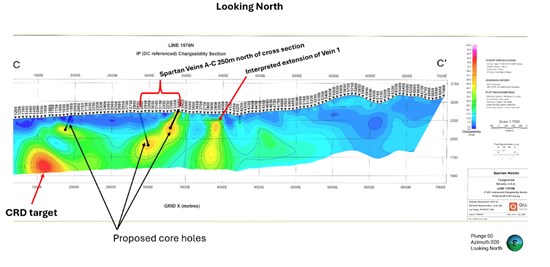
Figure 4 Cross Section C-C' showing IP (DC referenced Chargeability). 2026 core holes shown to test potential extension of the Spartan A, B, C Vein complex and geophysical anomalies on the edge of the Tungstonia Vein system in prospective sedimentary rock units.
To view an enhanced version of this graphic, please visit:
https://images.newsfilecorp.com/files/12484/314916_f495dda4d4b1c91d_004full.jpg
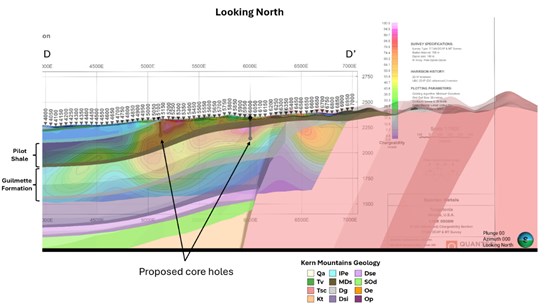
Figure 5 Cross Section D-D' showing IP (DC referenced Chargeability) with interpreted geological model within the southeastern extension of the SE Tungsten Anomaly. 2026 core holes shown to test high chargeability near surface targets (red, orange, and yellow contours) within the prospective Guilmette Limestone and Pilot Shale.
To view an enhanced version of this graphic, please visit:
https://images.newsfilecorp.com/files/12484/314916_f495dda4d4b1c91d_005full.jpg

To view the source version of this press release, please visit https://www.newsfilecorp.com/release/314916
